10 Cheapest Ways to Move Out of State in 2026
Quick answer: The cheapest way to move out of state is usually a DIY move using a rental truck, a moving container, or your own vehicle. You can save money on your move by decluttering, packing yourself, and moving in the off-season.
DIY truck rentals can start around $700, while full-service moving can cost more than $5,000. For maximum savings, rent a small truck or trailer, or consider freight services for a partial load. See our roundup of the best rental trucks to find the right fit.
Our track record





Each year, 400,000+ people trust our moving recommendations. Here are a few reasons why:
- Founded in 2015
- 4,500+ moving companies analyzed
- $50,000 in moving grants delivered
- Up-to-date pricing info & industry data
- Fact-checked for accuracy
Why moveBuddha?
- On average, moveBuddha users save more than 30% by comparing movers before booking.
- When you choose a moveBuddha Certified mover, you get $1,000 in added move coverage, plus dedicated support throughout your move.
- If something goes wrong, moveBuddha provides dispute mediation with Certified movers to help resolve the issue and protect your move.
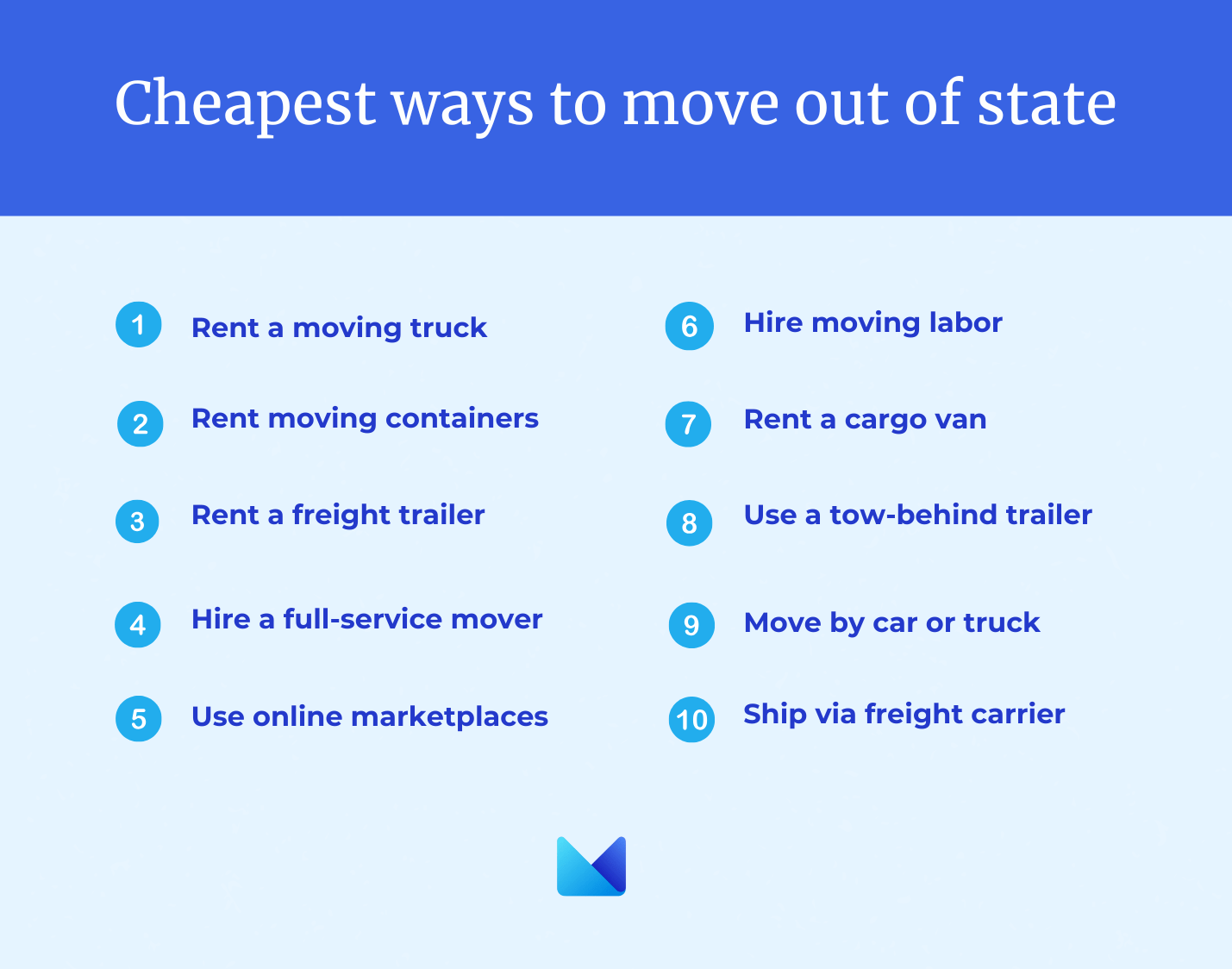
10 cheap ways to move out of state
Preparing for a cross-country move or long-distance move is different from a local move. A lot more can go wrong when you move out of state, and moving costs tend to be significantly higher.
Here are our top choices for cheap out-of-state moves, with the average cost and who they’re best for.
Jump to the cheap moving option you’re looking for:
- Rent a moving truck: Best for budget-friendly large moves ($700–$2,000)
- Rent moving containers: Best if you need storage ($900–$4,500)
- Rent a freight trailer: Best for larger moves ($1,500–$3,000)
- Hire a full-service mover: Best for convenience ($1,941–$4,224)
- Use an online marketplace: Best for getting a deal (Cost varies)
- Hire moving labor: Best for DIY hybrid moves ($1,175–$3,090)
- Rent a cargo van: Best for studio apartments ($800–$3,000)
- Use a tow-behind trailer: Best for shorter-distance moves (Cost varies)
- Move by car: Best for dorms and other small moves (Cost varies)
- Ship via LTL freight carrier: Best for flexible small moves ($1,021–$1,708)
1. Rent a moving truck: Best for budget-friendly large moves
With this option, you get the truck for a set number of days based on the distance of your move and do all the driving and heavy lifting. Because the moving company only provides a moving rental truck, you save significantly on moving costs. Factor in gas, hotels, meals, and drive time when planning your budget.
- Price match: Penske, Budget, and U-Haul will price match each other, so get quotes from all three even if you have a preference.
- Fuel costs: Account for fuel when budgeting. Diesel trucks get better mileage than gas-powered vehicles, so ask which type you’re renting.
- Request the newest truck: Ask for the newest available truck in the size you need to reduce the chance of maintenance issues on the road.
- Confirm your reservation: Call the day before your move to confirm and have a backup plan ready in case the truck isn’t available.
|
|
|
|




2. Rent moving containers: Best if you need storage
If you need temporary storage or don’t want to drive, a moving container is a great option. The container company delivers an eight- to 16-foot storage container for you to pack and load, then picks it up and ships it to your new home or holds it in storage.
- Compare container types: Companies like PODS and U-Pack offer different container sizes and service levels, so check which best fits your needs.
- Best rates near you: The cheapest moving container rates for out-of-state moves typically come from companies with locations close to both your origin and destination.
- Short-term vs. long-term storage: Moving container companies work well for short-term storage, but costs can exceed those of a standard storage unit over longer periods.
“U-Pack made my move stress-free and was the lowest quote of four container companies. My delivery even arrived early.”
— Read Gillian’s full story
|
|
|
|


3. Rent a freight trailer: Best for larger moves
Freight companies drop off a 28-foot trailer at your house and give you up to three days to load everything. Then they drive it to your destination and give you another three days to unload. Depending on the size of your move, you may need additional help with loading and unloading.
- Labor needs: This option doesn’t include movers, so plan for additional help if you have a large load.
- Best use cases: Freight trailers work well for rural moves or when you need quick delivery, but limited parking can make them tricky in cities.
- Vehicle transport option: Some freight companies will let you put a car in the trailer, which can be a cost-effective way to move both at once.
- Pack fragile items carefully: Trailers have spring suspension, so use extra padding around anything breakable.



 rating
 5 / 5
5 / 5
4. Hire a full-service mover: Best for convenience
Interstate moving companies are the right call if you have the budget and prefer not to do heavy lifting. They handle the loading, driving, and unloading. Full-service movers like Safeway Moving and Mayzlin Relocation can also pack your boxes and have a strong reputation for service quality. For a 1,000-mile move of a two- to three-bedroom home, expect to pay $1,941 to $4,224 for a full-service mover, according to moveBuddha pricing data.
- Higher cost: Full-service movers cost significantly more than DIY options. Moving containers and rental trucks run about 30% less on average, so weigh convenience against your budget.
- Compare multiple quotes: Quotes can vary by thousands of dollars, so get at least three before committing. Many movers will price match. You can explore movers in your area here.
- Verify licensing: Always confirm that an interstate mover is properly licensed by the FMCSA before booking.
- Deposits: Some full-service movers require an upfront deposit of up to 50% of your total moving costs.

|
|
 rating
 4.23 / 5
Licensed
Insured
Price
|


5. Use an online marketplace: Best for getting a deal
Use a platform like uShip to find professional help with tasks like packing and loading, including moving single items. You’ll get multiple quotes in a few minutes to find someone who fits your needs. Facebook and Craigslist are also options for finding local moving help.
- Vet every deal: If a price sounds too good to be true, it probably is.
- Check reviews carefully: Look at the transporter’s profile for past reviews and any red flags before agreeing to use their services.
- List of services: Keep in mind that service providers on these platforms typically don’t drive for you.
“Low quotes are sometimes used just to secure the job, knowing that the price will increase later. At that point, you’re stuck. That’s how bait and switch happens.” — Anthony Disorbo, Owner, American Van Lines
 rating
3.9 / 5
rating
3.9 / 5
6. Hire moving labor: Best for DIY hybrid moves
HireAHelper is a solid way to cut costs on your out-of-state move. The platform matches you with someone to load your moving truck or container. You can hire movers on an hourly basis and get peace of mind with a $1,000 money-back service guarantee.
- Vetting is handled: Platforms like HireAHelper vet moving labor for you.
- Transportation is on you: Moving labor can help with packing, loading, and unloading, but you’ll need to arrange your own transportation.
- Book for both locations: You’ll need separate crews at your origin and destination.
 rating
 4.5 / 5
7. Rent a cargo van: Best for studio apartments
Cargo vans are easier to park and navigate in traffic, and they get better gas mileage than a full-size moving truck. They’re available through some moving truck companies but are often limited to in-town moves. We recommend Penske for interstate van rentals and U-Haul for local moves.
- DIY loading: You’re responsible for all the lifting and loading, so factor that into your planning if you have heavy furniture.
- Packing supplies: Buy packing materials on your own to keep costs down.
- Check your space needs: For anything larger than a studio apartment, a cargo van likely won’t have enough room. A moving truck is the better fit for one-bedroom homes and larger.
8. Use a tow-behind trailer: Best for shorter-distance moves
A tow-behind trailer is a good option if your vehicle has the towing capacity. Rental companies like U-Haul offer tow-behind trailers in multiple sizes with no mileage fee. The largest cargo trailers are roughly the size of a small moving container, making them a fit for studio or one-bedroom apartments.
- Safety first: Trailers can be dangerous if you don’t have experience hitching and towing. Research trailer safety before your move day and never exceed your vehicle’s towing capacity.
- Budget for packing supplies: Factor in the cost of bubble wrap and packing tape.
- Drive cautiously: Go slowly, take wide turns, and leave extra stopping distance. Towing adds significantly to your braking time.
9. Move by car: Best for dorm rooms and other small moves
If you’re moving out of a dorm or another small space, you can often fit everything in your car. One advantage beyond the savings is that you’re moving your car and belongings at the same time. For temporary moves, you may need to put furniture in storage.
- Limited space: Pack carefully and bring only what you’ll need right away.
- Maintain visibility: Don’t block your rearview mirror or blind spots, or you could create safety and legal issues on the road.
- Overnight security: If the drive takes more than a day, park in well-lit, secure areas at night.
10. Ship via LTL freight carrier: Best for flexible small moves
LTL stands for less-than-truckload. The freight company combines your shipment with others to fill the truck and charges only for the space you use. LTL shipping is a flexible option if you’re not sure exactly how much you’ll be moving, though delivery typically takes longer than other methods.
- Space-based pricing: You pay for what you use, and the final cost adjusts after the move based on actual space. Get an upfront quote and understand how overages are billed.
- Pack tight: Pack as efficiently as possible to reduce how much space you take up in the truck.
- Damage risk: Multiple people handle the trailer during transit, which increases the chance of damage. Use extra padding and consider purchasing additional coverage.
- Palletizing: Some LTL carriers require items to be palletized. Package efficiently to avoid using extra pallets, which adds cost.
How to lower the cost of your out-of-state move
In addition to choosing the right moving service, there are several ways to stretch your moving budget.

Moving containers and rental trucks cost about 30% less than full-service movers on average, according to moveBuddha pricing data.
- Declutter: You can declutter before your move by selling things you no longer need at a garage sale or donating them. Downsizing enough can let you rent a smaller truck or container, which directly lowers your total cost.
- Move at off-peak times: Moving on weekdays between September and April comes with lower rates and more flexible delivery windows. Peak season runs May through August, when demand and prices are highest.
- Cheap moving boxes: Look for cheap or free moving boxes. Grocery stores, liquor stores, neighborhood Facebook groups, and Craigslist are all good sources.
- Ask for help: Friends and family can take a significant amount of labor off your plate on both ends of the move.
- Moving insurance: Check whether your homeowner’s or renter’s insurance covers moving. If it does, you can skip the mover’s optional coverage and potentially save hundreds.
- Moving discounts: Look for moving discounts for seniors, military service members, and others. Many movers also offer seasonal discounts.
- Parcel carriers: If you’re only moving a few items, consider shipping them via USPS or Amtrak Express.
Key factors that affect your moving costs
Three variables drive your out-of-state moving price more than anything else. Keep these in mind as you compare quotes and timelines.
- How much you move: Fewer belongings mean lower costs across the board. Downsizing before your move can cut hundreds or even thousands from your total.
- How much you do yourself: Handling packing, loading, and driving is almost always the cheapest route. Hybrid moves, where you hire labor-only help for the heavy lifting, keep costs down while saving your back.
- Your moving date: Peak season, weekends, and month-ends are the busiest and most expensive times to move. Weekdays between September and April typically deliver better rates and more flexible delivery windows.
Pro tip: Booking your move during fall or winter can save you hundreds on both rental trucks and full-service movers. See our full breakdown of peak moving season to find the best booking windows.
Real experiences from people who moved out of state
Here are a few insights from real customers we interviewed through our Better Moves Project on how they saved money on their out-of-state moves.
- Ship selectively: One mover shipped clothing and books via Amtrak Express for under $200 and drove only essentials in their car, cutting both time and rental costs.
- Get an accurate estimate: Laurel moved from California to Texas and found that an in-person or video survey prevents surprises, as her initial self-inventory underestimated the size of her load.
- Pay for protection where it counts: Jana paid $2,900 for a Connecticut-to-Ohio move and found it worth paying extra for professional packing on her artwork.
Which cheap moving option is right for you?
The cheapest way to move out of state is the one that fits your workload, timing, and the size of your shipment. If keeping costs low is the priority, compare DIY trucks and moving containers, book off-peak dates, and declutter aggressively.
For a quick, personalized estimate including fuel, labor, and other add-ons, use our calculator below.
How Much do Movers Cost?
Get instant ballpark pricing. No email or phone required. It's fast, free, and easy.
FAQ
What is the cheapest option to move out of state?
The cheapest option to move out of state depends on the size of your move. For a small dorm room-sized move, you may be able to transport everything in your own vehicle. For larger moves, a rental truck is typically the cheapest option. The more of the move you do yourself, the lower the cost.
What is the least expensive month to move?
The least expensive month to move is typically January, but moving anytime between September and April will generally get you lower rates than peak season. Try to avoid weekends and holidays during these off-season months to save even more.
What is the cheapest way to move a long distance?
The cheapest way to move a long distance is usually with a rental truck. If you’re not comfortable with long-distance driving, a moving container company or freight trailer can also be cost-effective since you only pay for transportation.
What is the easiest way to move from one state to another?
The easiest way to move from one state to another is with moving van lines. These full-service movers handle loading, transportation, and unloading and have networks that cover most of the United States. Many also offer add-on services like professional packing and unpacking.
How much does it cost to move to another state?
The cost to move to another state depends on distance, home size, and the type of moving service you use. For a 1,000-mile move of a two- to three-bedroom home, expect to pay $768 – $1,524 for a rental truck, $1,690 – $3,298 for a moving container, and $2,511 – $5,972 for full-service movers, according to moveBuddha pricing data.
Our research & review process
- We’re not a broker. We never sell or share your information.
- We mystery shop movers to get firsthand data.
- We interview moving customers through the Better Moves Project.
- We review movers’ licensing, insurance, and service history through moveBuddha Verified.
- We compare quotes and track market trends to provide accurate pricing guidance.

Not what you were looking for?
Check out other categories that can help you find the information you need!